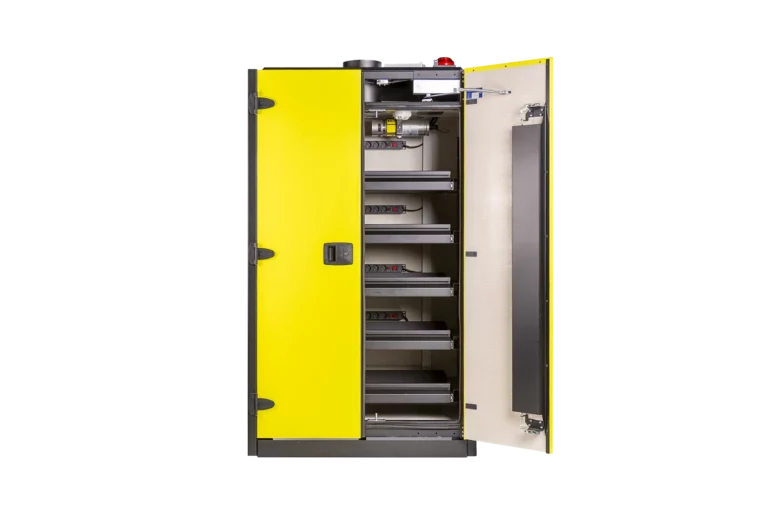
LOXK2000 VDMA Storage
Fire-resistant storage cabinet for lithium-ion batteries, VDMA 24994 tested. The simple and reliable solution for companies that want to store their batteries organised and safely.

Fire-resistant storage cabinet for lithium-ion batteries, VDMA 24994 tested. The simple and reliable solution for companies that want to store their batteries organised and safely.
Fire-resistant charging cabinet with pull-out shelves for lithium-ion batteries, VDMA 24994 certified. Designed for logistics environments where handheld scanners, walkie-talkies, and other portable equipment are safely and ergonomically charged.
Fire-resistant storage and charging cabinet for lithium-ion batteries, VDMA 24994 certified. The professional solution for companies that combine safety, capacity, and compliance.

Compact fire-resistant battery cabinet for the safe storage and charging of lithium-ion batteries in indoor environments. VDMA 24994 certified.

Weather-resistant charging locker for the safe charging and storage of e-bike and e-scooter batteries in outdoor environments. Six separate locked compartments, ready for placement next to any bike rack.

Fire-resistant charging locker with 12 individually lockable compartments for the safe storage and charging of lithium-ion batteries. Designed for environments where multiple users want to safely charge a battery at the same time.

The LOXXER Transport box is a UN-certified steel box for the transport and storage of all types of lithium-ion batteries and cells in accordance with ADR 4.1.4.1. Available in 600 and 800 litres.

The submersion container is a waterproof solution for safely extinguishing, cooling, and transporting electric and hybrid vehicles after an incident. By fully submerging the vehicle, battery temperature is stabilised and the risk of re-ignition is prevented.

The shelving container is a space-efficient solution for the safe and organised storage of lithium-ion batteries. Thanks to the stacked rack structure, the available floor space is optimally utilised, while batteries remain organised and quickly accessible.

The walk-in container is the versatile solution for safely storing lithium-ion batteries of various sizes, larger equipment, or even a small electric vehicle, all under one roof. Thanks to advanced fire protection systems and high fire resistance, the unit offers optimal safety for long-term storage.
No products found.
LOXXER is not a distributor of foreign products. We design, manufacture, and supply everything in-house, from Roeselare.
Full control over quality, customisation, and lead times. No intermediaries, no compromises.
Our products comply with the strictest European standards and are regularly retested by independent bodies.
From risk analysis to compliance documentation for your insurer. We take care of everything, from quote to completion.
Own offices in Belgium, the Netherlands, the United Kingdom, and Poland, complemented by preferred partners throughout Europe.
Incorrect charging is one of the most common causes of battery incidents. Overcharging, using an unsuitable charger, charging at too high or too low ambient temperatures, and charging damaged batteries are the main risk factors. All of these situations can lead to internal damage of the cell, gas formation, and ultimately thermal runaway. In professional contexts where multiple batteries are charged simultaneously, the risk spread is significant: an incident with a single cell can quickly escalate into a fire in an unsecured space that is difficult to control. A certified charging cabinet with smoke detection, thermal protection, and an integrated extinguishing system significantly eliminates that risk vector.
Lithium-ion batteries fall under the ADR regulations for the transport of hazardous materials by road. Depending on the capacity (expressed in watt-hours) and the condition of the battery (built-in, loose, charged or not), specific packaging and documentation requirements apply. Batteries with a high capacity that are transported as a loose unit require a certified transport box. The risk during transport mainly lies in mechanical shocks that can cause internal damage, which can lead to delayed thermal runaway even without visible damage. Those who regularly transport larger quantities of batteries should have the applicable ADR class and exemption rules assessed by a recognised hazardous materials advisor.
In a lithium fire, water or a standard CO2 extinguisher is often insufficient: the internal chemical reaction of a cell in thermal runaway continues as long as the cell is not completely cooled down. An aerosol extinguishing system works differently: it disperses a fine aerosol of potassium and nitrogen compounds that bind the free radicals in the flame reaction and thus chemically interrupt the combustion. In a closed cabinet or container, the aerosol concentration quickly builds up to a level that extinguishes or significantly suppresses the fire, providing time to prevent further escalation. The system does not completely extinguish the chemical reaction in the cell itself, but limits the spread to adjacent cells or to the space outside the cabinet. Therefore, certified LOXXER cabinets are equipped with both a smoke detector and an integrated aerosol AF-X extinguishing system as a combined solution.
Aerosol fire suppression systems come in two main categories: condensed aerosol and non-condensed aerosol. Condensed aerosol is the most commonly applied technology in the context of lithium battery applications. Upon activation, the system generates a fine mixture of solid particles and gas that chemically interrupts the combustion process by neutralising free radicals in the flame reaction. Systems are distinguished based on activation method (thermally automatic, electrically controlled, or manual), capacity, and the presence of integration with an external fire alarm control panel. For closed environments such as charging and storage cabinets, a compact, automatically activated aerosol system is the most logical choice.
A smoke detector detects the presence of smoke particles in the air as an early signal of fire or smouldering. The most common types are ionisation detectors, which use radioactive radiation to measure changes in air composition, and optical detectors (also known as photoelectric detectors), which send a beam of light and respond to smoke particles that scatter that light. In lithium fire safety, optical detectors are generally preferred because they are more sensitive to the smouldering, slow fire characteristic of battery incidents at an early stage. In the context of a LOXXER storage cabinet or container, an integrated smoke detector is part of the multilayer security strategy: early detection provides time to act before a situation escalates.
A visibly damaged battery that is deformed, leaking, unusually warm, or emitting a strange odour should not be charged or used. Immediately isolate the battery from other batteries and flammable materials and temporarily store it in a non-flammable environment, preferably a metal cabinet or container. Contact the manufacturer or supplier for further disposal instructions. Never dispose of a damaged lithium battery in regular waste or a standard e-waste container: the risk of delayed thermal runaway remains real as long as the cell is chemically active. For professional environments: document the incident and follow the internal protocol for hazardous materials.
In Belgium and the Netherlands, the relevant guidelines refer to PGS 37-2 (storage guideline for lithium-ion batteries in a business context) and the VDMA 24994 standard for charging and storage cabinets. These standards stipulate that batteries must be stored in fire-resistant, ventilated environments with sufficient distance from other flammable materials. For large-scale storage, a fire alarm system is mandatory, and staff must have an up-to-date emergency plan. Cabinets and containers that comply with VDMA 24994 are specifically validated for managing fire and preventing spread in the event of a battery incident. It is strongly recommended to have the specific situation assessed by a specialist beforehand: the damage from a fire always far exceeds the investment in correct infrastructure.
Request a no-obligation quote or call us directly. Our experts respond within 24 hours.