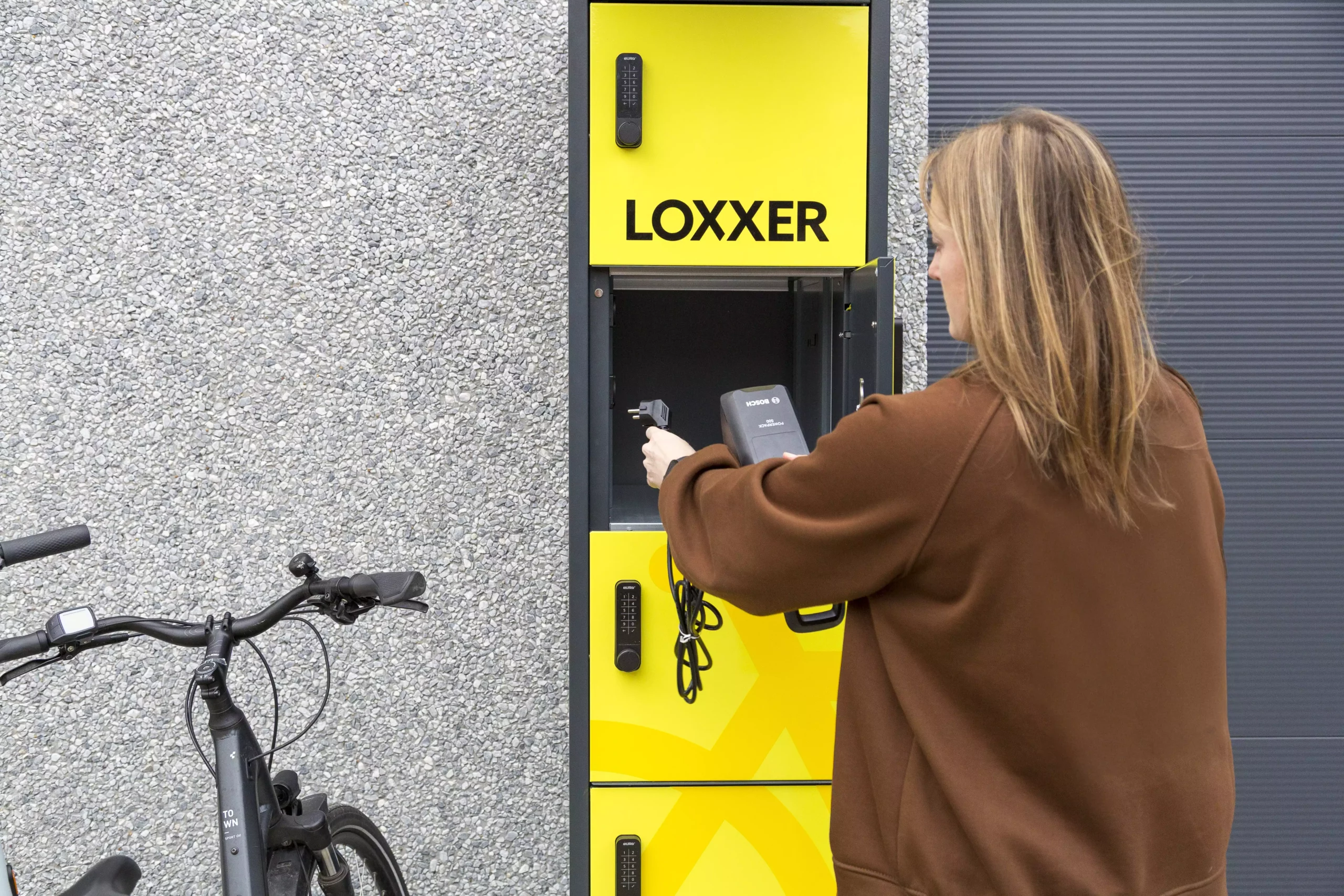
At the end of July in Zomergem, in East Flanders, the battery of a parked electric bike spontaneously caught fire. The garden shed burned down completely and the flames spread to the house and to the neighbours’ home. The residents will probably be unable to live in their house for a year. The bike was not connected to its charger at the time.
The story of the 63-year-old teacher was widely shared this week, and rightly so: it punctures the biggest misconception about lithium-ion batteries. Most people assume the risk exists as long as the plug is in the socket and disappears as soon as it is pulled out. In practice, it is different. The bike was five years old, had been ridden two days earlier and was partly standing in the sun. Barely anything was left of the aluminium frame. Aluminium only melts at around 660 degrees.
The risk does not stop at the charger
A battery that is not charging is not inactive. A large amount of chemical energy is still stored in a small volume, and that energy is released as soon as something goes wrong inside. This can happen weeks or months after a fall or a knock, without any visible sign on the outside. Fire services record fires during charging, during riding and with bikes that are simply standing in a garage, a storage room or a hallway.
The numbers are rising faster than the attention
Since 2019, a fire prevention expert has kept a database of electric bike fires in Flanders and the Netherlands, based on media reports. That register shows how quickly the problem is growing.
| 38 | 102 | 65 |
| registered e-bike fires in 2021 | registered e-bike fires in 2025, more than double | registered e-bike fires in 2026, up to early September |
Figures from the register kept by fire prevention expert Tim Renders, as reported by HLN on 12 September 2026. The actual number is higher: only incidents that make the press end up in the database.
What happens inside: thermal runaway
A battery pack consists of dozens of cells. Between the positive and negative poles of each cell is a wafer-thin separator layer. If that layer is damaged by a fall, a knock, wear or heat, a short circuit can slowly develop. At some point a hotspot forms, the cell overheats and drags the surrounding cells along with it. That is thermal runaway: a chain reaction that produces extreme heat and toxic, flammable gases within seconds. Extinguishing with water then barely works, because the reaction feeds itself. Read our explanation of thermal runaway.
What the fire service advises
There is no one-size-fits-all solution, because permanently keeping an e-bike outside is not an option for many people. Even so, a number of recommendations are crystal clear.
- Never store a battery in an escape route, so not in an entrance hall, corridor or stairwell.
- Choose a room where nobody sleeps, preferably behind a closed door.
- Fit a smoke detector above the place where the battery is kept or charged.
- Charge with the original charger and replace damaged cables immediately.
- Put a battery that has been knocked or dropped aside and have it checked.
- Do not leave a battery in full sun or in a sweltering delivery van.
“Only charge the battery when you are there.”
Hans Clarysse, chairman of Brandweervereniging Vlaanderen (Flemish fire service association), in HLN
One battery at home, dozens at work
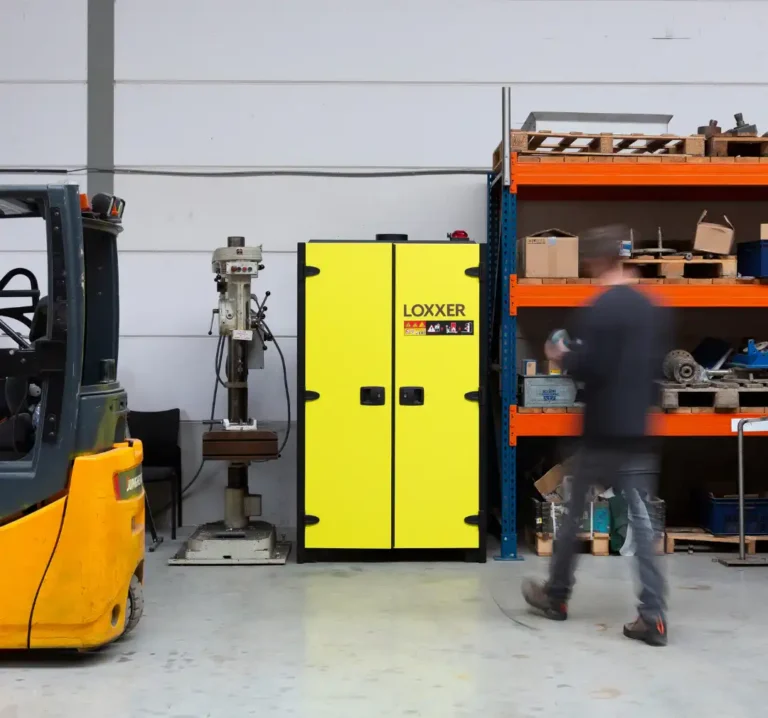
What is a single bike for a household quickly becomes a charging corner with dozens of batteries side by side in a bike shop, a school, a contractor or a green-space service. There, the risk does not add up, it multiplies: one cell in thermal runaway endangers everything on that charging table, plus the building, the stock and the people who work there. The same fire service association explicitly points to safety cabinets with an automatic extinguishing system as the solution for places where many batteries are kept together.

Quick risk check for businesses
- Are chargers located in or next to an escape route?
- Do batteries keep charging overnight without supervision?
- Are charged and damaged batteries stored together?
- Is there detection above the charging area, linked to an extinguishing system?
- Does your staff know what to do when smoke comes from a pack?
Three or more times yes? Then a fire-safe charging and storage cabinet is no longer a luxury.
What a fire-safe battery cabinet does differently
A LOXXER cabinet keeps an incident inside the cabinet rather than in the building. Detection picks up smoke and a rise in temperature before there are flames, an aerosol extinguishing system suppresses the reaction automatically, and the construction with thermal insulation and controlled pressure relief keeps the heat and gases away from people and stock. Our lithium cabinets are tested according to the VDMA 24994 guideline, the strictest reference currently available for charging and storage cabinets. You can read more about our aerosol extinguishing system in the knowledge base.
What about insurance?
According to the insurance sector, fire damage to insured goods caused by a battery fire is covered by fire insurance, as long as it concerns an accidental fire. Whether the battery was connected to the charger makes no difference in principle. The bike or the battery itself is usually not covered; that requires separate bicycle insurance. For businesses, the bill is rarely just material: downtime, lost stock and a building that is unusable for months often weigh more heavily.
Source of the incident discussed and the figures: HLN, 12 September 2026.
Your situation, your solution
Find out in two minutes which battery cabinet suits you
Answer a few questions about the type of battery, the quantity and where they are kept. You will immediately see the matching LOXXER solution. Prefer tailored advice? Our specialists will look at your charging area and draw up a concrete proposal.
Or call +32 (0)51 74 83 96 · info@loxxer.com