Stop counting in minutes. Start looking at what really matters. When it comes to fire safety, people often talk about ’60 minutes’ or ’90 minutes fire resistance’. That sounds clear and familiar, but with lithium-ion batteries, this way of thinking is no longer sufficient. At LOXXER, we consciously do not talk about ‘x minutes fire resistance’. And there is a good reason for that!
Classic fire tests: time as a measure
Traditional fire resistance classifications (such as EI60 or Type 90) were developed for external fire scenarios:
- Fire starts outside the enclosure
- The enclosure must withstand for 60 or 90 minutes
- The test stops after a predetermined time
But lithium-ion batteries behave fundamentally differently.
Lithium-ion fires: not a matter of minutes
A lithium-ion battery fire:
- Starts in the enclosure itself
- Consists of thermal runaway, with multiple ignitions
- Has no fixed duration
- Can last for hours, with reignitions
A test that simply stops after 60 or 90 minutes says nothing about what happens afterward.
The VDMA approach: testing in realistic scenarios
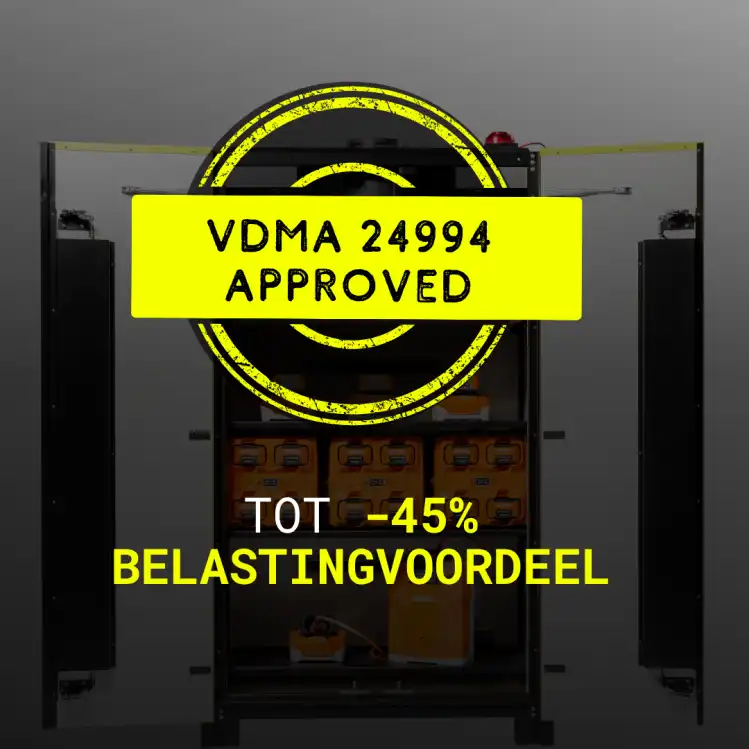
That is why LOXXER follows the VDMA 24994 methodology. This does not look at time, but at behavior and safety during a realistic battery incident. The enclosure is tested with:
- Battery explosions
- Thermal runaway of multiple cells
- Test duration: until the process is fully under control and the temperature decreases again
During the test, it is checked whether:
- The structure of the enclosure remains intact
- The doors remain closed
- The outside temperature remains safe
- No flames or projectiles escape
The test only stops when the danger is effectively over!